Share the CAD
STS reviews the mold base and hot runner, verifies available clearance and accounts for service features such as lift holes.

HOT RUNNER INSULATION / DME iControl™
Singh Thermal Systems supplies the insulation sold by DME as iControl. Only STS provides full process optimization; DME provides sales, logistics and in-country support as part of Hillenbrand’s DME & Mold-Masters business. Compatible with all major hot runner system OEMs, with insulation designed around each system’s geometry and clearances. Control heat loss at the manifold and nozzles for a more consistent thermal process. Greater control can enable cooler processing and faster cycles with the same or better part quality.
Review my application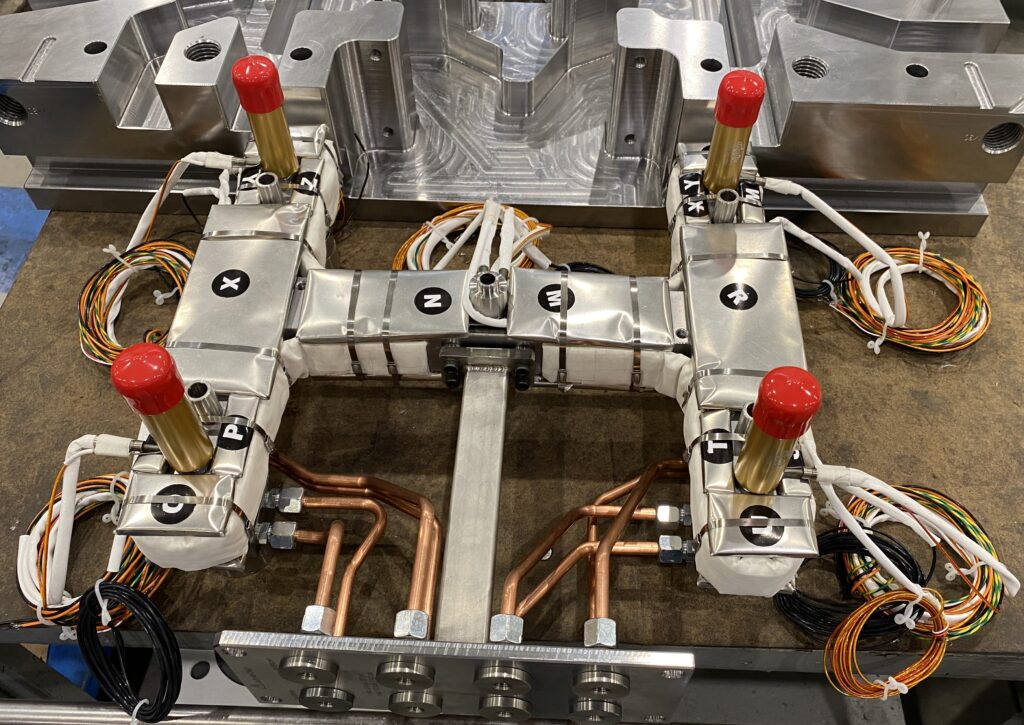
WHY INSULATE?
STS hot runner insulation helps isolate heat within the manifold and nozzle system. Limiting unwanted heat transfer to adjacent mold components helps minimize thermal variation and creates opportunities to optimize processing temperatures.
Reduction in energy required is the core STS product claim. Application conditions and measurement scope determine the result.
Review performance and evidence ↗APPLICATION REVIEW
Share the information below so STS can review the insulation configuration for your process. Our team can also provide a second set of eyes as you optimize the new processing window.
TECHNICAL QUESTIONS
STS insulation works with all major hot runner system OEMs. Compatibility is not limited to DME or Mold-Masters systems. STS reviews the mold and hot runner CAD, available clearances, nozzle geometry and service access to design the installation.
Yes. The hot runner insulation sold by DME under the iControl product name is Singh Thermal Systems insulation. Only STS provides full process optimization for this insulation. DME provides sales, logistics and in-country support.
Insulation limits unwanted heat transfer from the hot runner to surrounding components. Minimizing thermal variation gives the molder greater control over the thermal process. With greater control, most companies choose to run cooler. STS reports this can unlock 15% average cycle-time reductions with the same or better part quality. Validate processing changes for the resin and part.
DME offers standard panels and custom insulation for hot runner applications. Suitability depends on manifold and nozzle geometry, available clearance and service access. Send drawings to review the fit.
No. Energy use and cycle time are separate measures. STS reports that cooler processing enabled by greater control can unlock 15% average cycle-time reductions with the same or better part quality. Actual results depend on the application and process optimization; published DME examples are individual cases.
FROM CAD TO AN INSULATED HOT RUNNER
STS reviews the mold base and hot runner, verifies available clearance and accounts for service features such as lift holes.
Laser-cut quilted insulation provides flexibility around tight areas. Stainless-steel encapsulation suits rigid panels and hot-drop applications. Selected configurations can be as thin as 5 mm; fit requires engineering review.
Panels are identified and supplied with an assembly layout. Discuss a kit for your tool shop or an onsite retrofit. STS supports evaluation of revised process settings.
STS describes a typical 2–3 week design-to-panel-fabrication period. Confirm timing and installation scope with your quote.
GLOBAL SALES & LOCAL SUPPORT
STS insulation and full process optimization are complemented by DME’s sales, logistics and in-country support.
DME belongs to Hillenbrand’s DME & Mold-Masters business, an established global organization serving the mold and plastics-processing industries.
Explore Hillenbrand’s industrial brands ↗FULL PROCESS OPTIMIZATION — ONLY FROM STS
STS pairs insulation with a structured process review—from baseline settings and mold clearances to optimized temperatures, cycle components and part-quality validation.
In an automotive seat trim-ring project, insulation and process changes reduced the reported cycle from 44 to 39 seconds. Machine capability remained the next constraint.
Read the trim-ring case studyLET’S TALK ABOUT YOUR PROCESS