Ultra-high-performance insulation
Greater insulating performance enables thinner blankets. Each wrap is custom fabricated for barrel length, diameter, heater positions and thermocouple access.

BARREL INSULATION
Reduce energy required. Minimize thermal variation. Give your molding team greater process control.
Review my application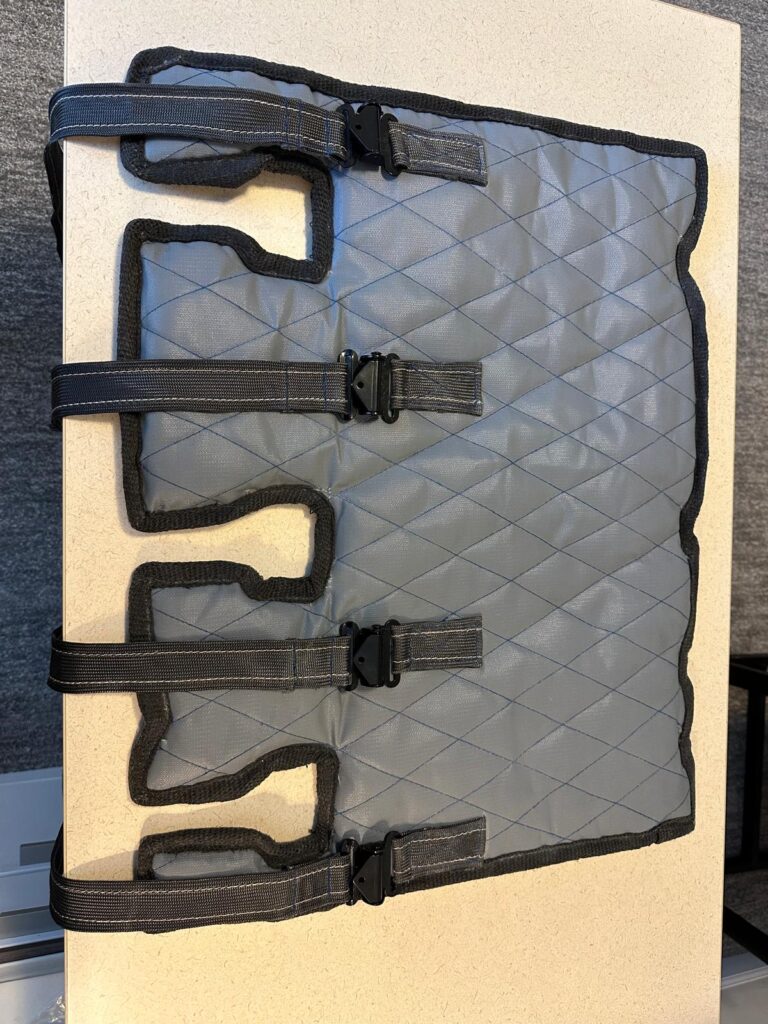
WHY INSULATE?
STS barrel insulation gives injection molders a practical way to lower energy costs as electricity rates rise. Retaining heat around the barrel reduces the energy needed to maintain the thermal process and helps minimize variation. Wraps are custom fabricated for barrel length, diameter, heater locations and thermocouple positions. Ultra-high-performance insulation enables thinner blankets. Premium external materials provide greater durability and ease of maintenance, while military-grade spring-loaded buckles support quick installation and release.
Reduction in energy required is the core STS product claim. Application conditions and measurement scope determine the result.
Review performance and evidence ↗APPLICATION REVIEW
Share the information below so STS can review the insulation configuration for your process. Our team can also provide a second set of eyes as you optimize the new processing window.
TECHNICAL QUESTIONS
Yes. Reducing heat loss can lower the electricity required by the barrel heating system. The STS trial reported 32.1% lower barrel energy consumption over 12 hours. Bill savings depend on actual kWh saved, operating hours and the applicable electricity tariff; total facility bill savings are not the same as the barrel-energy reduction.
Ultra-high-performance insulation enables thinner blankets. Premium external materials provide greater durability and ease of maintenance, while military-grade spring-loaded buckles support quick installation, removal and refitting.
Barrel insulation limits heat loss from the heated barrel to the surrounding environment. STS insulation is designed to reduce energy required and minimize thermal variation for greater process control.
Yes. Send the machine make and model, barrel dimensions, heater-zone layout and photographs. STS can review fit, access requirements and the intended operating conditions.
STS states a reduction in energy required of 30% or more. Validate the result for the insulated system under comparable production conditions; total machine and factory electricity savings depend on how much of their demand comes from that system.
Provide barrel diameter and heated length, zone dimensions, heater and thermocouple locations, operating temperatures, machine quantity and photographs. Include any access or clearance restrictions.
PREMIUM MATERIALS. PRACTICAL ADVANTAGES.
Greater insulating performance enables thinner blankets. Each wrap is custom fabricated for barrel length, diameter, heater positions and thermocouple access.
Premium fastening hardware makes installation and release straightforward, supporting convenient removal and refitting for maintenance.
Durable outer materials make the blankets easier to maintain. The insulation is selected to withstand repeated thermal cycling and retain its effectiveness.
MEASURED BARREL INSULATION TRIAL
150-ton electric press. High-temperature polycarbonate processed at approximately 550°F in a climate-controlled facility.
| Configuration | Energy consumed | Reduction |
|---|---|---|
| Barrel without insulation | 18.7 kWh | Baseline |
| Barrel with STS insulation | 12.7 kWh | 6.0 kWh / 32.1% |
Source: STS Barrel Insulation technical presentation, December 2023, customer trial in Asia. Values as reported in the trial table. Energy savings depend on heater type, process temperatures and ambient conditions. Apply your actual electricity tariff to measured kWh savings when estimating bill reductions; demand and fixed charges must be evaluated separately.
FROM MEASUREMENTS TO INSTALLATION
With the machine safely isolated and cooled, have qualified personnel follow the machine’s procedures for access. Record the barrel and zone dimensions, heater locations and thermocouple positions.
Send dimensions and photographs to STS. Custom fabrication accounts for length, diameter and required access.
Install the wraps, verify clearances and restore required guarding before operation. Compare energy use under equivalent production conditions.
LET’S TALK ABOUT YOUR PROCESS